Expansive Effects
To understand our neighborhood — the Moon, the Sun, and the rest of the Milky Way — all we need is gravity.

But astronomers have seen something strange in the vast expanses between galaxies that seems to defy gravity — space itself is expanding.
Do you think this expansion affects our ability to communicate with faraway galaxies?
Yes, a lotMaybe a littleNo, not at all
Actually, this seemingly distant effect has important intergalactic consequences. Let’s see why.
We’ll start with a simple scenario: stretching a rubber band.

If you marked two points on the band, what would happen to the points as you stretch the band?
The points would get farther apart
The points would get closer together
The distance between the points wouldn’t change
Why?
Distances in an expanding universe react similarly to those in a stretching rubber band. With this in mind, we can begin to unravel the mechanics of expansion.
What direction do other galaxies appear to be moving relative to us?
Us
Why?
Explanation
Imagine an ant sitting on one point of the rubber band while it is getting stretched. Since the distance to the other point is increasing, it will seem to the ant that the other point is moving away.
The same happens for galaxies in expanding space. Since the intergalactic distances are increasing, all distant galaxies appear to be moving away.
In an expanding universe, galaxies will appear to be moving away from each other.
Us
Reset
Let’s explore the speed of this galactic retreat.
To do this, we’ll need to measure intergalactic distances. These are so large that it’s inconvenient to use everyday units like kilometers. Instead, we’ll use megaparsecs, where 1 Mpc≈3×10¹⁹ km.1 Mpc≈3×10¹⁹ km.
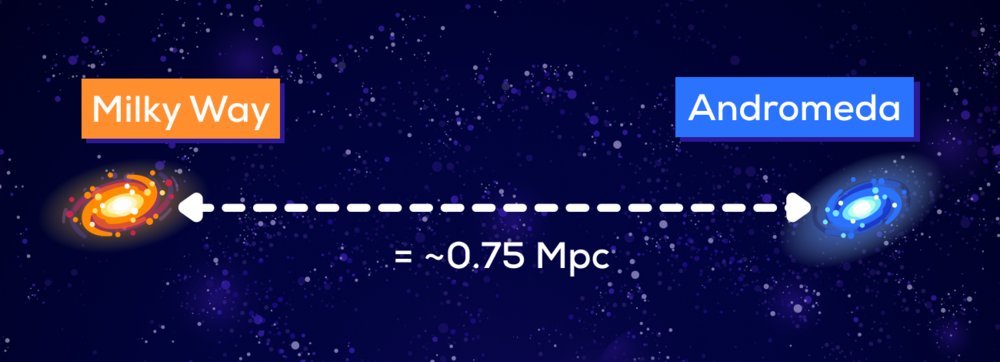
To give some perspective, the Milky Way is about 0.75 Mpc0.75 Mpc away from Andromeda, the biggest neighbor in our local group of galaxies.
On a human scale, 1 Mpc1 Mpc is almost unimaginably far — Voyager 11 is the furthest man-made object in space, and after more than 4040 years, moving at 17 km/s17 km/s it has traveled less than one trillionth of a megaparsec.
Consider two galaxies, one 100 Mpc100 Mpc away from us and the other 200 Mpc200 Mpc away from us.
If expansion is happening the same way everywhere, how fast would these two galaxies be moving away from us?
100 Mpc100 Mpc
Us
Why?
Explanation
Imagine you marked 33 points on a rubber band in order. When you stretch it, the extra distance between points 11 and 33 is the sum of the extra distance between 11 and 22 and between 22 and 33 — so the furthest pair of points are moving apart fastest.
Galaxies in expanding space behave the same way — the farther apart they are, the faster the distance in between them is increasing. This means that a farther galaxy will appear to be moving away faster.
If expansion is happening everywhere, there will be more expansion between galaxies that are farther apart, so they’ll move away from each other more quickly.
Expansion
Play
We can quantify this universal expansion with an expansion rate E.E.
Which of these equations could describe the apparent velocity vv due to the expansion between two galaxies a distance dd apart?
v=Ev=E
v=Edv=Ed
v=Edv=Ed
Why?
Explanation
From the animation above, we see that we can find the expansion within a certain distance by splitting that distance into pieces and summing the expansion within each smaller piece. The same approach applies if we want to find the apparent velocity due to expansion.
This is consistent with velocity being proportional to the total distance, which is captured in the equation:
v=Edv=Ed
The apparent velocity between two galaxies is proportional to the distance that separates them, so a galaxy that is 10×10× as distant will be retreating 10×10× as fast. The expansion rate EE acts as the constant of proportionality.
Astronomers’ measurements correspond to E≈70 (km/s)/Mpc.E≈70 (km/s)/Mpc. That is, each 1 Mpc1 Mpc of distance in space is expanding at about 70 km/s.70 km/s.
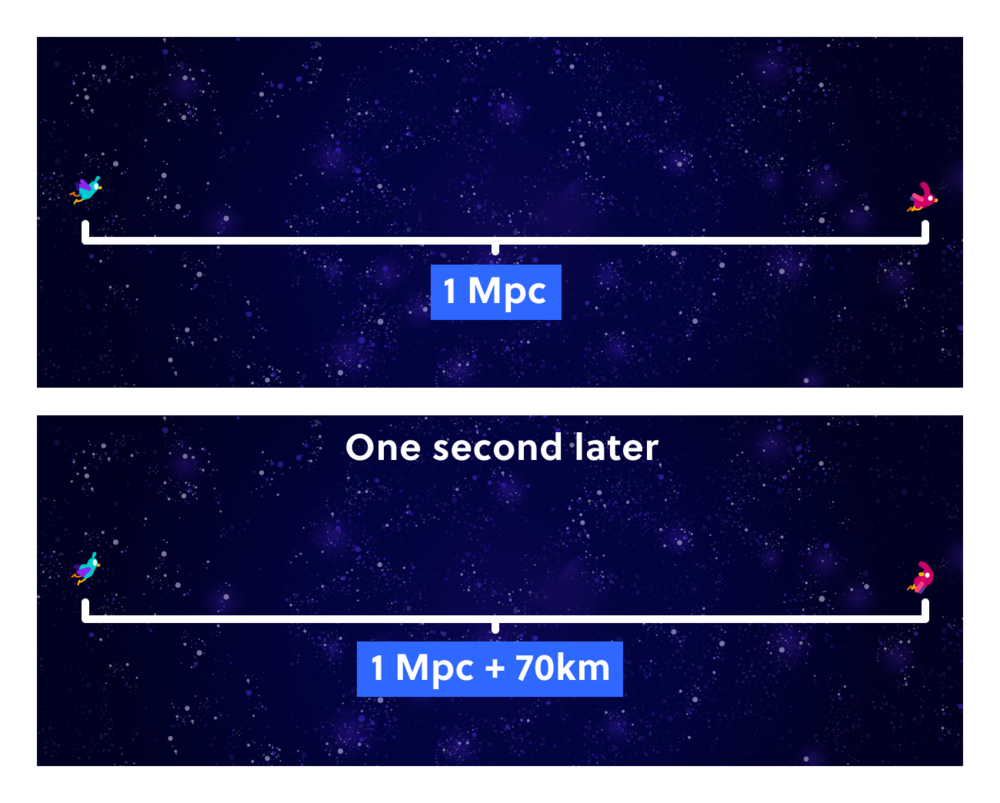
This is the constant expansion rate we’re going to assume in this lesson — it’s accurate enough for the approximate calculations we’re making.
This expansion might seem negligible — after 11 year a megaparsec will only expand 7×10⁻¹¹ Mpc,7×10−11 Mpc, increasing by a tiny fraction of itself. After 11 billion years, a distance will expand by about 7%.7%.
As slow as this is, it could be very consequential for intergalactic travel.
How long would it take a spaceship traveling 70 km/s70 km/s to reach an asteroid 1 Mpc1 Mpc away?
1 Mpc/70 km/s≈141 Mpc/70 km/s≈14
billion years
About
3030
billion years
About
100100
billion years
It never gets there
Why?
Explanation
The apparent velocity of an object 1 Mpc1 Mpc away is 70 km/s.70 km/s. This means that if you moved towards the object at 70 km/s,70 km/s, you wouldn’t be getting any closer to it, it would stay the same distance away from you — you’d never reach it.
The apparent velocity of the asteroid due to expansion is
v=Ed=70 (km/s)/Mpc×1 Mpc=70 km/sv=Ed=70 (km/s)/Mpc×1 Mpc=70 km/s
This means that the space between the ship and the asteroid is increasing at 70 km/s70 km/s — the same speed the ship is traveling — and the spaceship would never get any closer to its target.
1 Mpc
Let’s consider a speed with more universal significance than 70 km/s70 km/s — the speed of light c.c.
What is special about the speed of light with regard to reaching distant galaxies?
Moving close to light speed slows down time
Nothing can move faster
It’s the speed of massless particles
It’s true that time experienced by something traveling near light speed can get wonky, but it’s also the universal speed limit — cc is the fastest speed that anything can move through space.

The speed of light is 3×10⁵ km/s.3×105 km/s.
If a galaxy is far enough away from us, its recession velocity will equal the speed of light. This distance is known as the Hubble radius RH,RH, the distance at which objects currently have a relative velocity greater than c.c.
cc
RHRH
RHRH
We can calculate RHRH by using the expansion velocity equation and setting v=c,v=c, and d=RH.d=RH.
Use the expansion equation to find RH.RH.
v=Ed
v=Ed
RH=
RH=
Explanation
We start with our velocity equation:
v=Edv=Ed
After substituting in the velocity and distance of interest, we have:
c=ERHc=ERH
Dividing both sides by E,E, we find:
RH=c/ERH=c/E RH is an incredibly long distance of about 4300 Mpc.4300 Mpc. To give some perspective, it would take light over 1414 billion years to travel this far.
Even though nothing can move through space faster than c,c, objects can seem to be moving away from us faster than c.c. This is possible even if the object isn’t moving — it’s due to the expansion of space itself
If the expansion rate changes over time, the Hubble horizon RHRH — which corresponds to a recession velocity of cc at the current moment — would not match up perfectly with the cosmological event horizon Re.Re.
For example, in a universe where EE is increasing, RHRH would be decreasing over time. Light emitted just inside RHRH could get “overtaken” by RH,RH, and eventually find itself at a position with a recession speed greater than c.c. In such a universe, ReRe would be smaller than RH,RH, since some light emitted inside the current RHRH would never reach us.
Astronomers believe that EE is decreasing, and will settle on a value around 57 (km/s)/Mpc57 (km/s)/Mpc after billions of years.
This corresponds to a cosmological event horizon of around Re=5000 MpcRe=5000 Mpc — larger than our Hubble radius of RH=4300 Mpc,RH=4300 Mpc, but still reasonably close.
Out of Reach
How does our reachable universe change over time?
Suppose we have a neighboring red galaxy on the left and a neighboring green galaxy on the right, and all three are currently within each other’s reachable universes.
After some time, expansion has pushed us all apart. We are still in range of both red on the left and green on the right, but they aren’t in range of each other.
Can red send a message at light speed to green through us?
Based on distances, we know that we can send a message to red or green, but red and green can’t communicate, regardless of what we do.
This is because expansion leads to things looking different by the time light travels from one galaxy to another.
hi!
Reset
Even though our reachable universe has a constant radius of 4300 Mpc,4300 Mpc, the number of galaxies in it is decreasing over time — our reachable universe is shrinking.
Eventually it will only consist of our local group of galaxies.
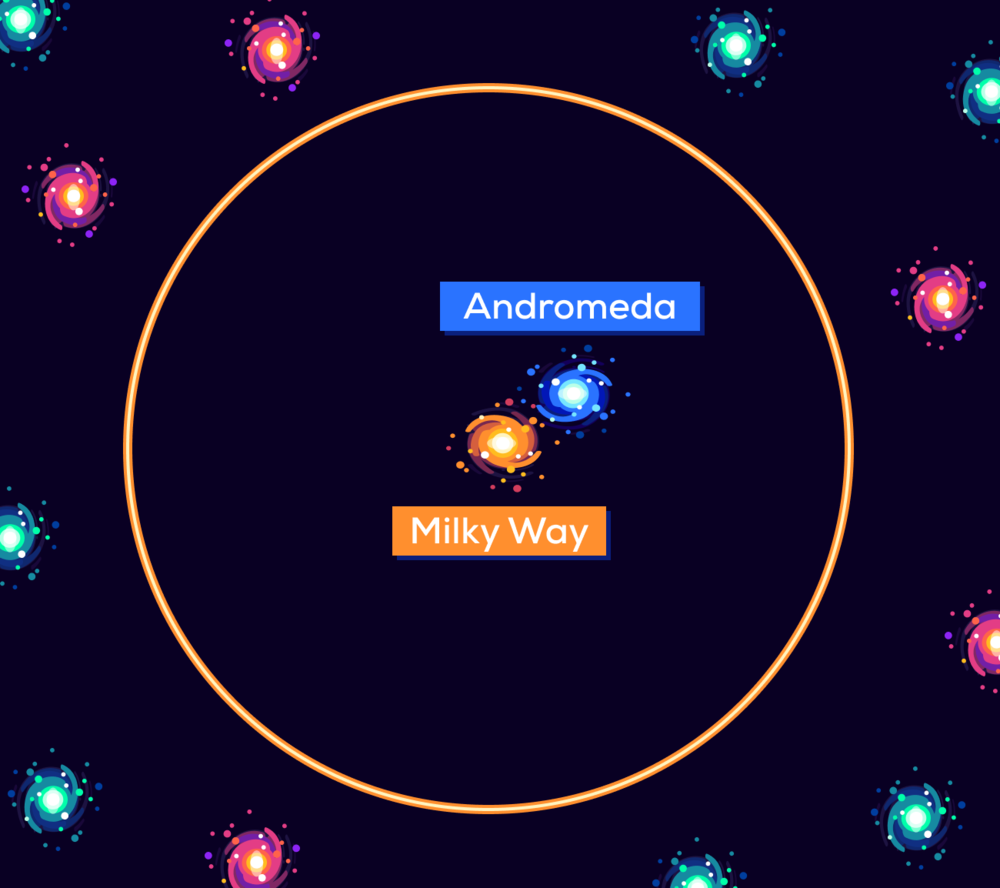
Let’s calculate how long it will take for our universe to become this lonely.
Remember, you can use the equation v=Edv=Ed to find the relative velocity between galaxies, and we’re assuming a fixed expansion rate of E=70 (km/s)/Mpc.E=70 (km/s)/Mpc.
Let’s consider a pair of galaxies, one that’s 100 Mpc100 Mpc away from us, and another that’s 200 Mpc200 Mpc away from us.
100 Mpc100 Mpc
Us
What will take longer: the first galaxy being 200 Mpc200 Mpc away from us, or the second being 400 Mpc400 Mpc away from us? Explanation
From the equation v=Ed,v=Ed, we know that relative velocity is proportional to distance. This means that the second galaxy will recede twice as fast as the first galaxy, and will “travel” twice the distance in the same amount of time.
This means that the first galaxy and the second will double their distances in the same amount of time. A distance will double in tt billion years when 2=1.07t.2=1.07t. The proper way to solve this equation is with logarithms:
Let’s estimate the doubling time for expansion in our universe. Recall that in 11 billion years, a distance in space will expand by about 7%7% of itself.
让我们估计一下宇宙膨胀的倍增时间。回想一下,在 11 亿年后,太空中的距离将扩大大约 7%7% 自身。
当 2=1.07t.2=1.07t. 求解这个方程的正确方法是使用对数时,距离将在 tt 亿年中加倍:
2=1.07tlog2=t×log1.07t=log2log1.07t≈10.242log2tt=1.07t=t×log1.07=log1.07log2≈10.24
so a distance doubles in about 1010 billion years.
所以距离在大约 1010 亿年内翻了一番。
If you’re not familiar with logarithms, you can get a rough estimate by dividing 100%100% (the growth required for the distance to double) by 7%/1 billion years,7%/1 billion years, which gives about 1414 billion years. This is an overestimate because it assumes a constant rate of expansion, ignoring the acceleration of expansion as distance increases.
如果你不熟悉对数,你可以通过将 100%100% (距离翻倍所需的增长)除以 7%/1 billion years,7%/1 billion years, 来得到一个粗略的估计,得到大约 1414 十亿年。这是一个高估,因为它假设膨胀速率恒定,而忽略了随着距离增加而加速膨胀。
f a distance expands by a factor of 1.071.07 in 11 billion years, then it will double in tt billion years when 2=1.07t.2=1.07t. This corresponds to a doubling time of about 1010 billion years.
如果距离在 11 亿年中扩大了 1.071.07 倍,那么它将在 tt 亿年中翻倍,当 2=1.07t.2=1.07t. 这对应于大约 1010 亿年的倍增时间。
The Maffei group is our closest neighboring local group at about 3 Mpc3 Mpc away.
Maffei 组是我们最近的邻近本地组,距离大约 3 Mpc3 Mpc 。

Once the distance between us has doubled enough times to push it out of our reachable universe, we will be eternally alone.
一旦我们之间的距离翻了一番,足以将其推出我们可触及的宇宙,我们将永远孤独。
Explanation 解释
How long will it take the Maffei group to leave our reachable universe?
Maffei 集团需要多长时间才能离开我们可到达的宇宙?
It takes between 1010 and 1111 doublings before the Maffei group will leave our reachable universe. Since each doubling takes about 1010 billion years, this corresponds to a travel time between 100100 and 110110 billion years.
在 1010 和 1111 之间翻倍后,Maffei 小组才会离开我们可到达的宇宙。由于每次加倍大约需要 1010 亿年,这对应于 100100 和 110110 亿年之间的旅行时间。
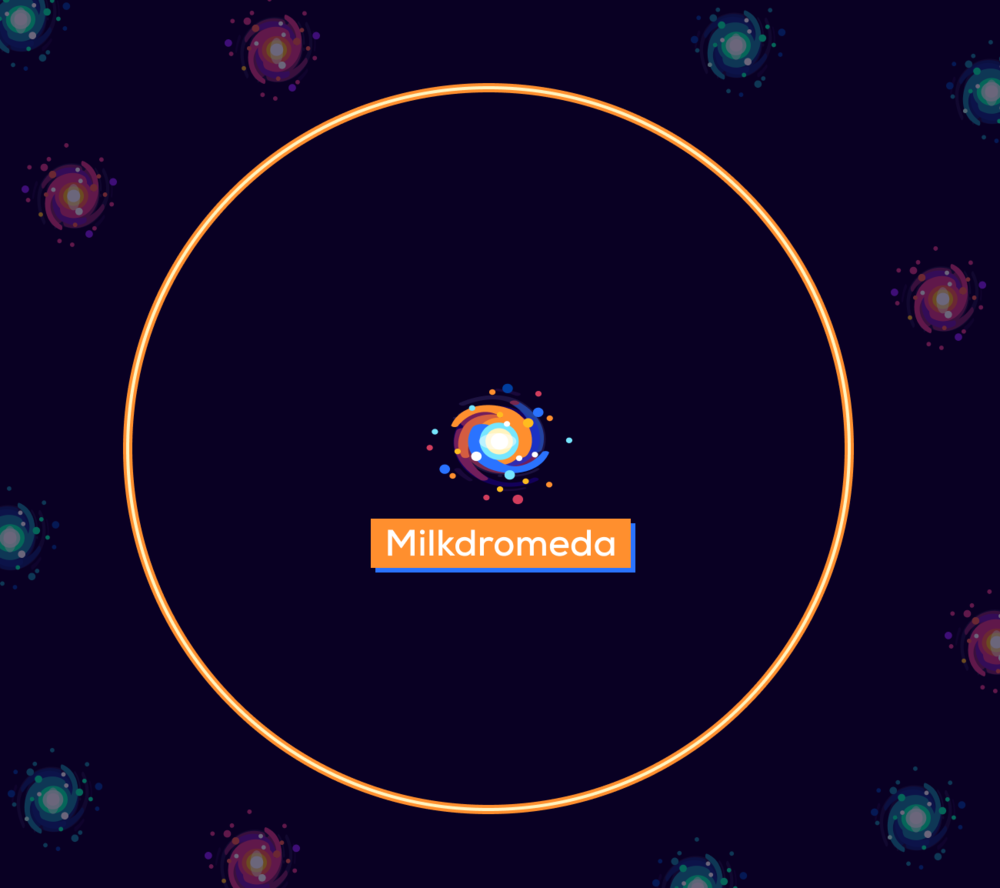
Our Sun will die in around 55 billion years, and the Milky Way will collide with Andromeda in around 44 billion, but the resulting Milkdromeda galaxy will be around for another 11 trillion.
我们的太阳将在大约 55 亿年内死亡,银河系将在大约 44 亿年内与仙女座相撞,但由此产生的乳单峰女座星系将再存在 11 万亿年。
This means that, beyond our local group, our reachable universe will be empty well before all our stars die.
这意味着,在我们的本地星群之外,我们可到达的宇宙将在我们所有的恒星死亡之前很久就空无一人。

But there’s more to the universe than what we can reach — expansion also influences what we can see.
但是,宇宙的意义远不止我们所能达到的——膨胀也会影响我们能看到的东西。
Out of Sight 遥不可及
With a powerful telescope, you can see many galaxies beyond our local group.
使用强大的望远镜,您可以看到我们本地星系群以外的许多星系。

If light from a galaxy is reaching Earth, then it’s part of our observable universe — the set of all celestial objects that we can detect.
如果来自星系的光到达地球,那么它就是我们可观测宇宙的一部分——我们可以探测到的所有天体的集合。
How do you think the observable universe compares to the reachable universe?
您认为可观测宇宙与可到达宇宙相比如何?
We received light from the red galaxy — we could see it — after it was outside our reachable universe. This means that the observable universe contains more galaxies than the reachable universe.
我们从红色星系接收到光——我们可以看到它——在它超出我们可到达的宇宙之后。这意味着可观测宇宙包含的星系比可到达的宇宙多。
Our reachable universe is shrinking — what about our observable universe?
我们的可观测宇宙正在缩小——我们的可观测宇宙呢?
What will it look like to someone on Earth observing this galaxy in the night sky?
对于地球上在夜空中观察这个星系的人来说,它会是什么样子?
It will suddenly blink out into darkness
它会突然眨眼进入黑暗
Its image will freeze, never changing again
它的图像将冻结,永远不会再次改变
They wouldn’t notice anything unusual (✅) 他们不会注意到任何异常
What will it look like to someone on Earth observing this galaxy in the night sky?
对于地球上在夜空中观察这个星系的人来说,它会是什么样子?
It will suddenly blink out into darkness
它会突然眨眼进入黑暗
Its image will freeze, never changing again (✅) 它的图像将冻结,永远不会再次改变
They wouldn’t notice anything unusual
他们不会注意到任何异常
Now consider another situation — an astronomer looking into the sky sees a star blink into existence.
现在考虑另一种情况 — 一位天文学家望向天空,看到一颗星星眨眼而生。
Is this star within our reachable universe?
这颗星星在我们可到达的宇宙中吗?
That’s right. 没错。
If a new star is born nearby, we’ll definitely see it while we can still reach it, but a new star born near the edge of our reachable universe would leave before its light reached us.
如果一颗新恒星在附近诞生,我们肯定会在我们还能到达它的时候看到它,但是一颗诞生在我们可到达的宇宙边缘附近的新恒星会在它的光到达我们之前离开。
What does this tell us about our observable universe?
It’s expanding(✅)
It’s shrinking
It’s not changing
Explanation
Stars that we have never seen before — including some that are now outside our reachable universe — are having their light reach us for the first time.
When this happens, that star has entered our observable universe for the first time, and our observable universe grows. Even though galaxies are leaving our reachable universe and will never be able to return, we are still seeing stars that we’ve never seen before. This means that our observable universe is expanding.
Play
This offers us a consolation prize, but it doesn’t mean that our future is bright.
The farther a galaxy is from us, the dimmer its light will appear. That’s because light expands outward in a sphere. The farther we are from the source, the bigger the sphere that the original light is spread out over.
星系离我们越远,它的光就会显得越暗。这是因为光线在球体中向外扩展。我们离光源越远,原始光散射的球体就越大。
Observed Particles: 0 观察到的粒子数:0
Is there a limit to how far light can travel before reaching us?
光在到达我们之前可以传播多远是有限制的吗?
Yes 是的
It’s true that we’ll never see light that was emitted outside of our reachable universe, but it’s still possible for light to reach us after traveling more than 4300 Mpc.4300 Mpc.
确实,我们永远不会看到在我们可到达的宇宙之外发射的光,但光在传播超过 @0 之后仍然有可能到达我们
As an example, light emitted 4000 Mpc4000 Mpc away from us will need to travel more than 4000 Mpc4000 Mpc to reach us, since the intervening space will expand from its initial distance while the light is making its journey.
例如,从我们身边发射的 4000 Mpc4000 Mpc 光需要传播超过 4000 Mpc4000 Mpc 才能到达我们,因为当光正在行进时,中间空间将从其初始距离扩展。
The closer a source is to the edge of the reachable universe when it emits its light, the farther its light will travel on the way to us. The farther it travels, the dimmer it will appear in our telescopes.
当光源发出光时,它越接近可到达宇宙的边缘,它的光在到达我们的路上就会传播得越远。它飞行得越远,它在我们的望远镜中就会显得越暗。
What does this mean for the far future of our expanding observable universe?
这对我们不断扩大的可观测宇宙的遥远未来意味着什么?
It will never get dimmer
它永远不会变暗
It will eventually settle on some fixed dimness
它最终会沉淀在一些固定的昏暗上
It will keep getting dimmer forever
它会永远变暗
Explanation 解释
There is no limit to how far light might travel before reaching us. Because light from distant galaxies appears dimmer to us the farther it has traveled through space, there is no limit to how dim light will appear to us in the far future.
光在到达我们之前可以传播多远是没有限制的。因为来自遥远星系的光在太空中传播得越远,对我们来说就越暗,所以在遥远的未来,光线对我们来说会有多么暗淡。
Light emitted closer and closer to the edge of our reachable universe will have to travel through more and more space before reaching us.
发射的光越来越接近我们可到达的宇宙的边缘,在到达我们之前将不得不穿过越来越多的空间。
Eventually, all the light we’re receiving will have traveled through so much space that it will be too dim to detect, and we won’t be able to see anything beyond our local group.
最终,我们接收到的所有光都将穿过如此多的空间,以至于它太暗而无法检测到,我们将无法看到本地群体以外的任何东西。
 In reality, it’s not just this dimming effect we need to worry about. The light reaching us also red shifts, getting stretched into longer wavelengths as the space it’s moving through expands. So in addition to being dimmer, it will shift from visible light to infrared, to microwave, and eventually to undetectably long radio waves.
实际上,我们需要担心的不仅仅是这种调光效应。到达我们的光线也会发生红移,随着它所穿过的空间的扩大而被拉伸成更长的波长。因此,除了变暗之外,它还会从可见光转变为红外线、微波,并最终变成无法察觉的长无线电波。
Astronomers predict that in 300300 billion years it will be nearly impossible to detect any light originating from outside our local group.
天文学家预测,在 300300 亿年后,几乎不可能检测到任何来自我们本地群体之外的光。
For a period before all the stars in our galaxy die out, we will appear to be in a relatively empty universe. Nothing outside our galaxy will be visible, and the night sky won’t offer any hints about the origin of the universe.
在我们银河系中的所有恒星都消亡之前的一段时间内,我们似乎处于一个相对空旷的宇宙中。我们银河系之外的任何东西都看不到,夜空也不会提供任何关于宇宙起源的线索。
This lonely future is all due to expansion of the universe.
这个寂寞的未来,全都是宇宙膨胀的结果。
Review and Reflect 回顾和反思
Slowly but surely, space is expanding. While this has little impact over human timescales, it will fundamentally alter what our universe looks like in the far future.
太空正在缓慢但肯定地扩大。虽然这对人类的时间尺度影响不大,但它将从根本上改变我们宇宙在遥远未来的面貌。
Eventually, our local group will become separated from every other galaxy in the universe — not only will it be impossible to reach another galaxy, it will be impossible to see them.
最终,我们的本地星系群将与宇宙中的其他星系分离——不仅无法到达另一个星系,而且也无法看到它们。